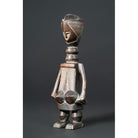
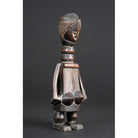
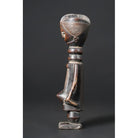
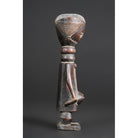
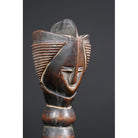
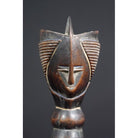
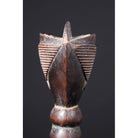
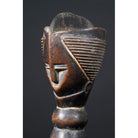
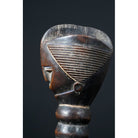
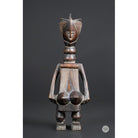
Mende Female Figure, Sierra Leone / Liberia #892
Pickup available at 16 East 17th Street
Usually ready in 24 hours
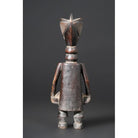
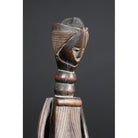
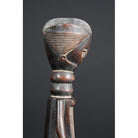
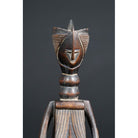
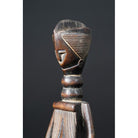
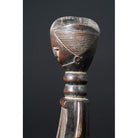
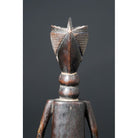
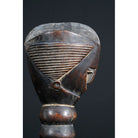
A Mende sculpture of a woman, Liberia, high abstract and of remarkable position of the female breasts, natural brownish patina, significant traces of a touchpatina.
Mende sculpture, particularly from Sierra Leone, is shaped by a clear division between artistic production and social authority. Wood carving is traditionally a male activity, and therefore Mende sculptures are carved by men, even when the subject of the work is female. The act of carving is associated with technical skill, physical labor, and esoteric knowledge that is culturally assigned to men.
Despite this, women occupy a central and authoritative position in Mende art. Many of the most significant Mende sculptural forms, especially the Sowei masks, represent women and embody ideals of female beauty, morality, and social maturity. These masks are used in the context of the Sande society, a powerful women’s association responsible for the initiation and education of girls. While men produce the physical objects, women commission them, own them, and control their ceremonial use.
The function of women in Mende art therefore extends beyond representation to governance and meaning. The sculptures serve as visual expressions of female values such as self-discipline, fertility, wisdom, and moral authority. Through their role in the Sande society, women determine how and when these artworks appear, and what social messages they communicate. Mende sculpture thus illustrates a cultural system in which artistic labor is male, but symbolic power and social function are firmly rooted in women’s authority.
Boone, Sylvia Ardyn. Radiance from the Waters: Ideals of Feminine Beauty in Mende Art. New Haven: Yale University Press, 1986.
Phillips, Ruth B. “Masking in Mende Sande Society Initiation Rituals.” African Arts 12, no. 1 (1978): 58–65.
Little, Kenneth. The Mende of Sierra Leone. London: Routledge & Kegan Paul, 1951.
Lamp, Frederick John. Art of the Baga: A Drama of Cultural Reinvention. New York: Museum for African Art, 1996. (Useful for regional secret-society context, including Sande/Sowei traditions.)
Bascom, William. “The Focus of African Art.” African Arts 10, no. 1 (1976): 32–35.

Pickup available at 16 East 17th Street
Usually ready in 24 hours
Pickup available, usually ready in 24 hours
16 East 17th Street
Ground Floor
New York NY 10003
United States
We truly love that you're making things, but unfortunately we do not buy things consignment or purchase outside work.
We have a reliable network of suppliers and are not currently in the position to purchase your collections. But we're thrilled that you thought of us.
Unfortunately no, we cannot create custom designs or sizes for our customers. However, you may be able to shorten them / decrease the width of the designs we offer slightly by manipulating the wires that connect the beads together.
A: It depends on a variety of factors. Get in touch with us to let us know what you're interested in learning, and we'll let you know if it's a possibility.
A: We do indeed sell at wholesale prices to those who meet our requirements. We have a general policy and a Wholesale Plus+ program for larger companies than would truly like to purchase in bulk. To learn about our wholesale policies, please see here.
A: Beads of Paradise does not, at anytime, give loans (pulls), secured or unsecured. We do however do rentals for stylists. Please see here for more info.
A: We love working with you when possible. Please send us a picture and or a description of what you're interested in and we'll be in touch.
It is our policy that NO Labor is done “on the spot”/”while you wait”. Any exceptions to this are at the discretion of the management and only at the discretion of the management. All items at Beads of Paradise are sold “As Is” with no warranty implied or expressed. If you have a problem with one of your purchases, please ask to see a manager. Thank you for your understanding.
For most pieces of jewelry on our site, we should be able to accommodate a request such as this, with some exceptions. You can purchase and leave a note when you purchase, or get in touch with us to inquire (please include a link to the product in question).
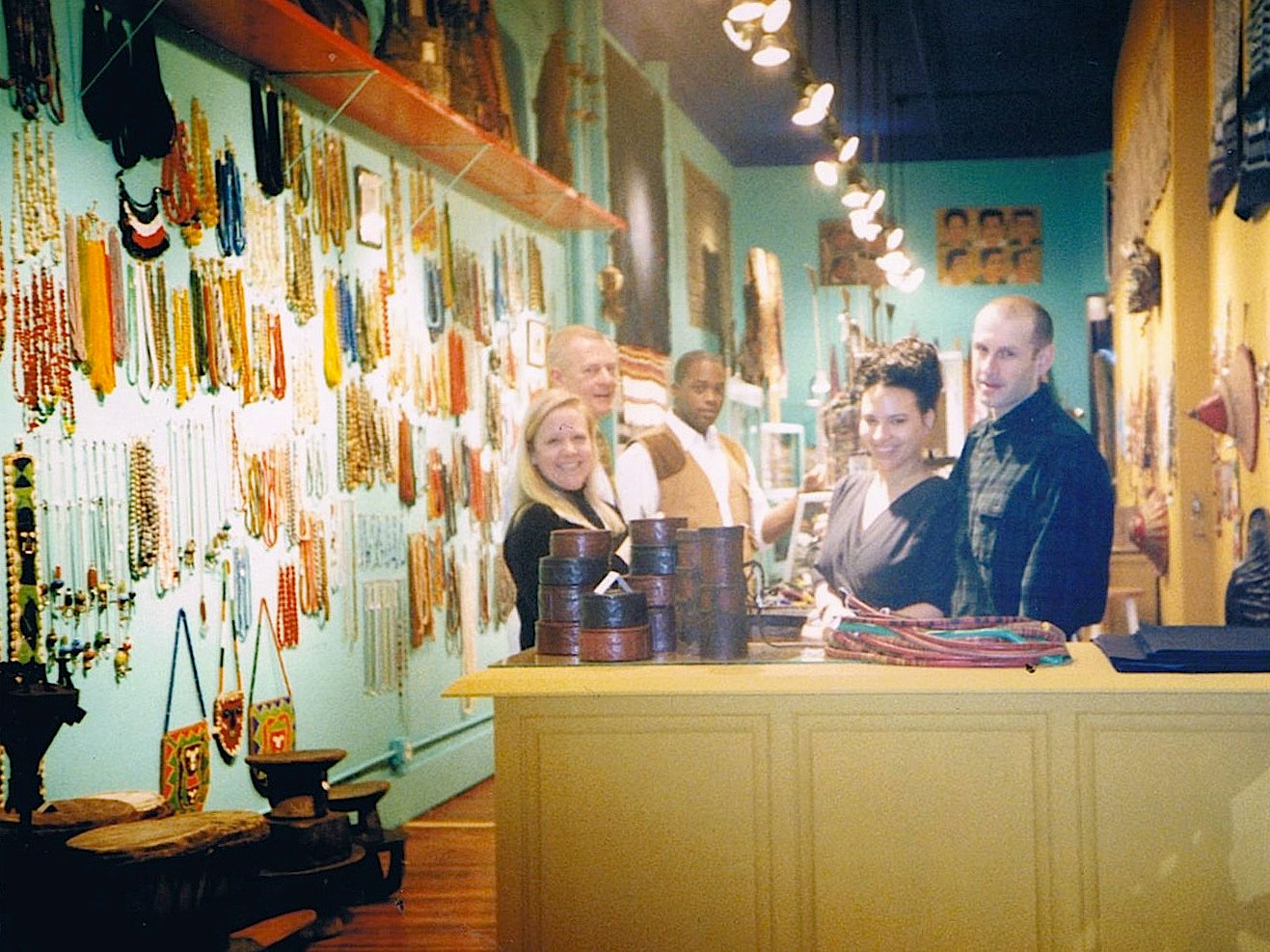
Beads Of Paradise began in the late 1980’s as a small store in the East Village. We originally specialized in African antiquities, textiles, beads and jewelry – but as interest in world art and beads grew throughout the 1990s, we underwent a major expansion and moved to our current location in the historic Flatiron district of New York City. Read More; A Visual History