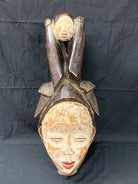
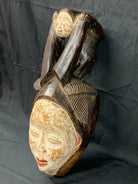
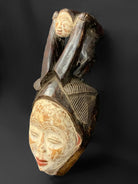
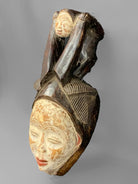
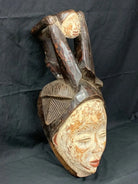
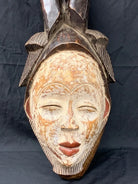
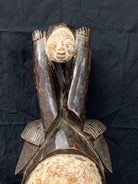
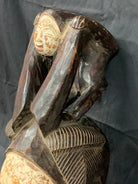
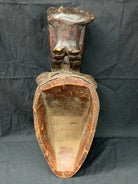
- Punu Mukudj Mask, Gabon #108
- Measurements: 21" high x 9" wide
-
Condition: Good, with a worn patina of Ritual Use and care.
-
Punu Masks from Gabon, known as Mukudj (Mukudji or Mukuyi—the names of the Ceremonies at which they appear and the Stilt Dances associated with them), represent an Idealized Female Ancestor, symbolizing beauty, serenity, and the Spirit World. White kaolin-covered faces signify the Afterlife, and Ancestral Wisdom. Worn by male stilt-dancers, these Masks mediate between the Living and Dead, often in Funeral or Celebratory contexts.
-
Key Symbolism and Meaning of Punu Masks
Idealized Female Ancestor: Representing the "Most Beautiful Women", these Masks feature high-domed foreheads, elaborate coiffures, and diamond-shaped scarification (lozenge-shaped) on the forehead/ temples.
White Kaolin Clay: The white pigment, derived from local riverbeds, symbolizes Peace, the Afterlife and Spirits of the Dead.
Serenity and Inner Vision: The eyes are usually half-closed, reflecting Meditation, Inner Peace, and a connection to the Spiritual Realm.
-
Black Masks (Rare): While most are white in pigmentation/ painting, black-colored Punu masks (Ikwaras) exist, generally representing Judicial or Protective Functions during Illnesses or Witchcraft-related Issues.
Black Punu masks were believed linked to a Judiciary Process such as searching for Witches, an Enquiry into a Crime, or a Trial by Poison.
-
According to Louis Perrois, the category "masks with black painted faces" make up about 8% of the corpus of the Punu Masks. The black-faced
masks represent Angry Spirits, and are therefore considered potentially dangerous to handle them. According to Perrois (1979: 235) the black patina on Punu masks is presumably an index of its more serious or darker role in Judiciary Services, potentially Condemning the Living, whereas Punu Masks layered in white kaolin are used in Celebrations and Funerary Ceremonies.
-
Cultural Identity: Today, these Masks are recognized as a key emblem of Punu Identity and were sometimes displayed in Villages for their Cultural Significance.
The masks typically feature a heart-shaped face with a small, pointed chin and are crafted from wood, often accompanied by elaborate costumes of fiber or raffia.
-
The creator of a "Mukudj" Mask would attempt to capture the likeness of the most beautiful woman in his Community. The Subject of this particular idealized and stylized portrait was embellished in classic nineteenth-century fashion with a coiffure composed of a central lobe and two lateral tresses and with cicatrization motifs on the forehead and temples. Kaolin taken from riverbeds, which was associated with healing and with a Spiritual, Ancestral Realm of Existence, was applied to the surface of the face. By using this material, the Artist both celebrated the Beauty of a Mortal Woman and transformed her likeness into a Transcendent Being.
-
Punu Masks were only worn by male members of the Mwiri society, who dance on tall stilts on the occasion of Celebrations marking the end of Mourning, and more generally at important social events in the life of a Community. Their joyful, acrobatic walkabout performances are reminiscent of their former role as initiators and guarantors of social order, the cleanliness of community spaces, and even the moral behavior of the inhabitants.
-
Origin is Gabon